Strait of Hormuz Explained: Why 21 Miles of Water Sets the World Oil Price
Every time tension rises in the Gulf, the same phrase turns up in the headlines: the Strait of Hormuz. It gets called "strategically vital" and the explanation usually stops there, which tells a reader nothing useful.
Here is the concrete version. How wide it actually is, how much oil moves through it, where that oil is going, and why the alternative routes do not solve the problem.
How narrow is the Strait of Hormuz?
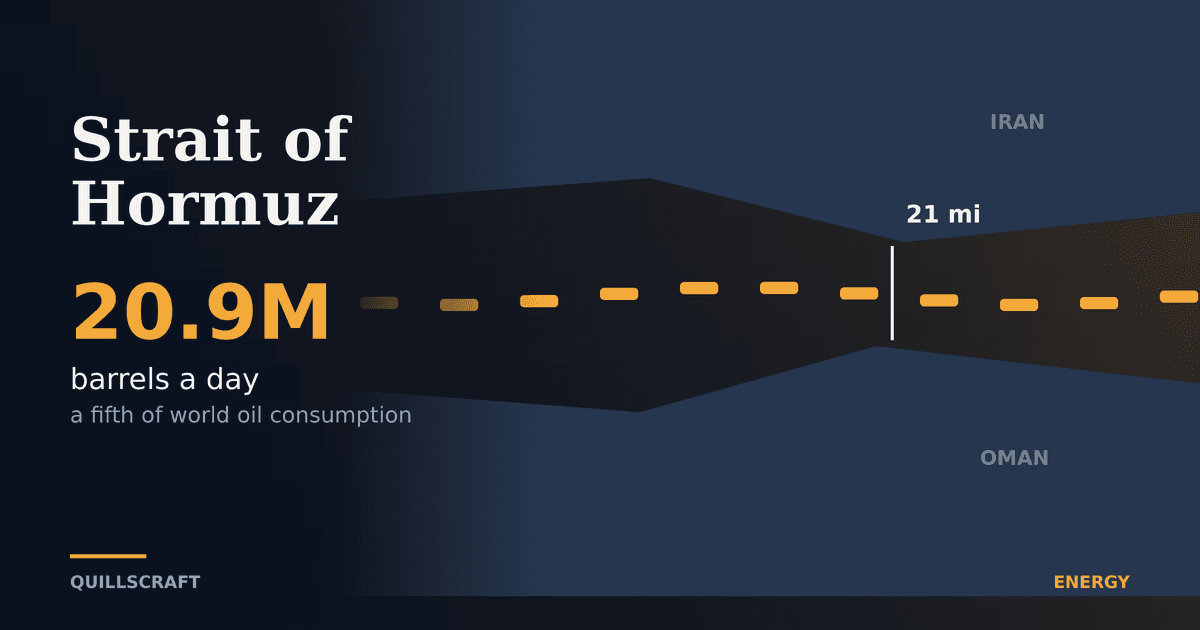
At its tightest point the strait measures about 21 miles across, sitting between Iran to the north and Oman to the south.
That number flatters it. Traffic is confined to two shipping lanes, each roughly two miles wide, separated by a two-mile buffer zone. So the working channel for the world's largest tankers is closer to six miles than twenty-one.
Depth runs to around 200 feet. Deep enough for a fully laden supertanker, but shallow by open-ocean standards, and it limits how far a vessel can stray from the marked lanes.
What that adds up to is a corridor where a large share of global energy trade moves through a few miles of water, on entirely predictable routes, within easy reach of the shoreline.
How much oil passes through it?
About 20.9 million barrels per day moved through the strait in the first half of 2025, according to the US Energy Information Administration's chokepoint analysis. That is roughly a fifth of global oil consumption.
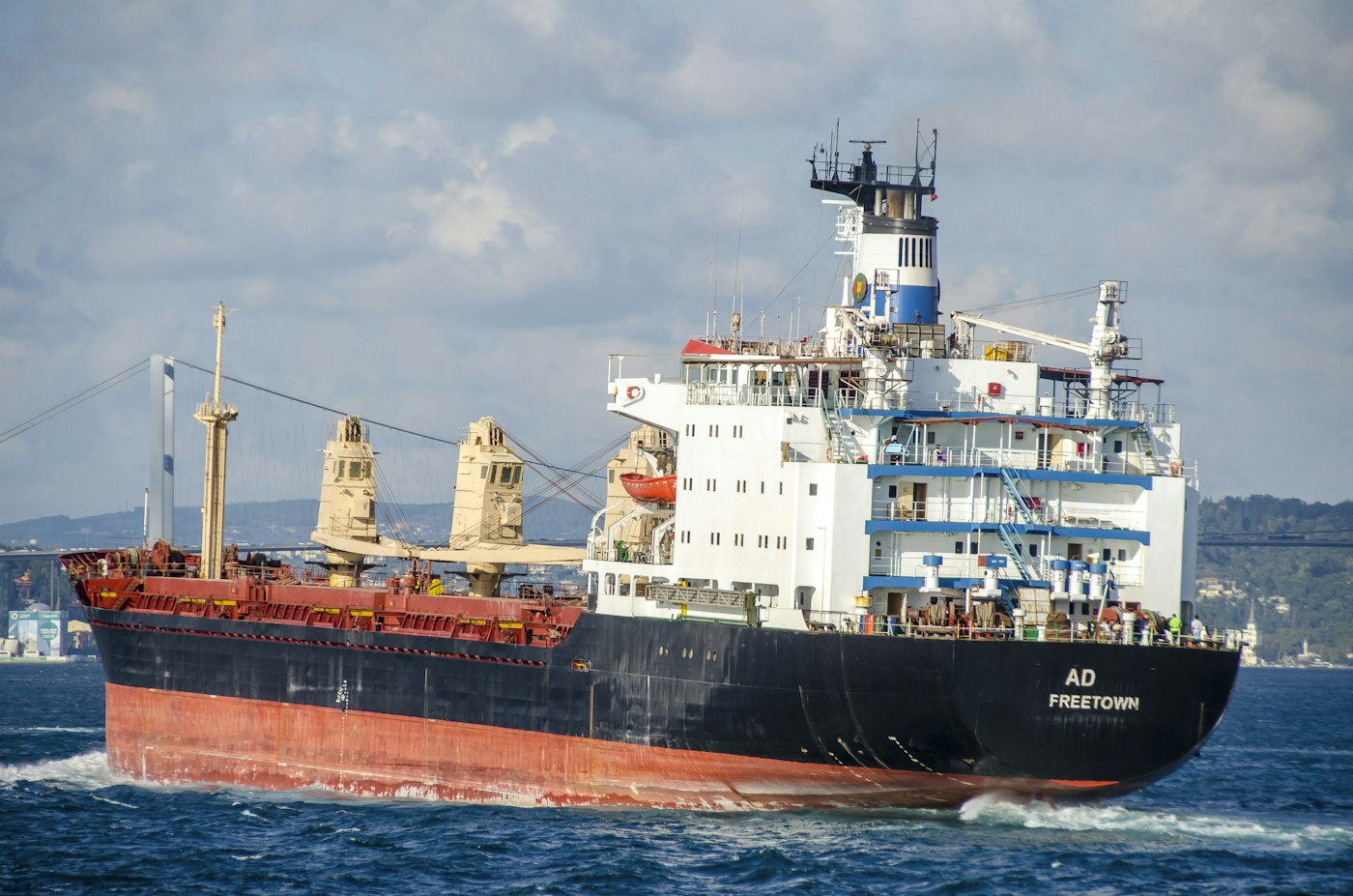
The composition matters more than the headline figure:
Around 15 million barrels per day of crude oil and condensate
Around 5.5 million barrels per day of refined products, including diesel, jet fuel, and fuel oil
Most coverage drops that second number, and dropping it changes the picture. A disruption at Hormuz is not purely a crude story. It also hits the finished fuels that go straight into vehicles, aircraft, and heating systems, which is part of why the effect on pump prices can show up faster than a crude-only analysis would predict.
The volumes move around, too. EIA figures show flows falling from an estimated 20.7 million barrels per day in late 2025 to 14.6 million in the first quarter of 2026. The agency cautions that recent ship-tracking data is unreliable, so treat that as a working estimate rather than a settled number.
Where does the oil actually go?
Roughly 84% of the crude leaving through Hormuz is bound for Asian markets.
This is the detail that reframes the subject for most Western readers. The strait tends to get discussed as though it were primarily a US or European supply line. It is not. It is overwhelmingly the artery feeding Asian economies.
That does not make it irrelevant to American drivers, because oil is priced globally. A barrel that fails to reach Asia is a barrel missing from world supply, and the price effect reaches every market, including ones that import nothing through the strait at all. What it does mean is that the countries with the most direct physical exposure are not the ones usually pictured.
Why can't tankers just go around?
Mostly they cannot, and this is the part that gets skipped.
Two countries operate crude pipelines able to bypass the strait: Saudi Arabia and the United Arab Emirates. The main Saudi route is the Petroline, also called the East-West Pipeline, running about 745 miles from Abqaiq across the country to the Red Sea.
Three things limit how much that helps:
Capacity. Bypass pipelines carry a fraction of what moves by sea through Hormuz.
Availability. Some of that capacity is not currently operating or operable, so headline numbers overstate what could realistically be used at short notice.
Cost and onward risk. Rerouting adds expense and complexity, and the Red Sea carries its own security problems. Oil moved away from one threat can arrive at another.
Qatar, one of the world's largest LNG exporters, has no pipeline bypass whatsoever. Its cargoes transit the strait or they do not move.
So when analysts call Hormuz a chokepoint rather than just a busy route, they mean it literally. At the volumes involved, there is no substitute path.
Why threats move prices even when the oil keeps flowing
Traders do not wait for a closure. They price the odds of one.
An attack on a single tanker signals that the corridor is unsafe. Marine insurers raise war-risk premiums, which adds cost to every cargo whether anything else happens or not. Shipowners delay sailings, reroute, or demand higher charter rates. Governments assign naval escorts. Buyers build precautionary inventory, and that buying is itself extra demand.
Every one of those adds cost without a single barrel being lost. It explains why crude can jump on news of an incident that damaged one vessel, and why prices sometimes stay elevated well after the immediate danger has passed. The risk premium outlives the event.
For how this reaches drivers in the United States, see our explainer on why gas prices rise and the timeline of the 2026 US-Iran conflict.
Has the strait ever been closed?
It had not been, until 2026. Iran threatened closure repeatedly for decades without acting, but traffic was halted during this year's conflict and only resumed after the June 18 memorandum of understanding reopened the strait.
That record cuts in two directions. It suggests closure is harder and less appealing than the rhetoric implies, partly because Iran's own exports depend on the same water, and partly because the 84% of transiting crude bound for Asia serves buyers Iran has reason to keep on side.
It also means the worst case has never actually been tested. Every estimate of what a genuine closure would do to prices is a model, not an observation. Be suspicious of confident numbers.
The realistic risk was never a clean closure anyway. It is what the 2026 crisis actually produced: harassment, occasional strikes on individual vessels, and enough uncertainty to raise costs across the whole system while traffic keeps moving.
Frequently asked questions
How wide is the Strait of Hormuz at its narrowest?
About 21 miles. The usable shipping channel is far narrower: two lanes of roughly two miles each, separated by a two-mile buffer.
What percentage of world oil goes through the Strait of Hormuz?
Roughly one fifth of global oil consumption. In the first half of 2025 that came to about 20.9 million barrels per day, split into around 15 million of crude and condensate and 5.5 million of refined products.
Can oil bypass the Strait of Hormuz?
Only partly. Saudi Arabia and the UAE run bypass pipelines, including the 745-mile Petroline to the Red Sea, but combined capacity covers a fraction of seaborne volumes and some of it is not currently operable.
Which countries depend on the strait most?
Asian economies. About 84% of the crude transiting Hormuz is headed for Asian markets.
Has Iran ever closed the Strait of Hormuz?
Yes, in 2026. Before that it had been threatened many times over several decades without ever being fully closed, in part because Iranian exports rely on the same waterway. Traffic through the strait picked up again after the June 18 US-Iran memorandum, and the EIA expects flows back near pre-conflict levels by the end of the year.
Bottom line
Hormuz matters because geography handed the world's largest oil-producing region a single practical exit, six miles of working width, and nothing adequate to fall back on.
That is why one damaged tanker moves the global oil price, and why "strategically vital" is carrying an enormous amount of weight in most headlines. The strait's importance is not really about politics. It is about there being nowhere else for the oil to go.


