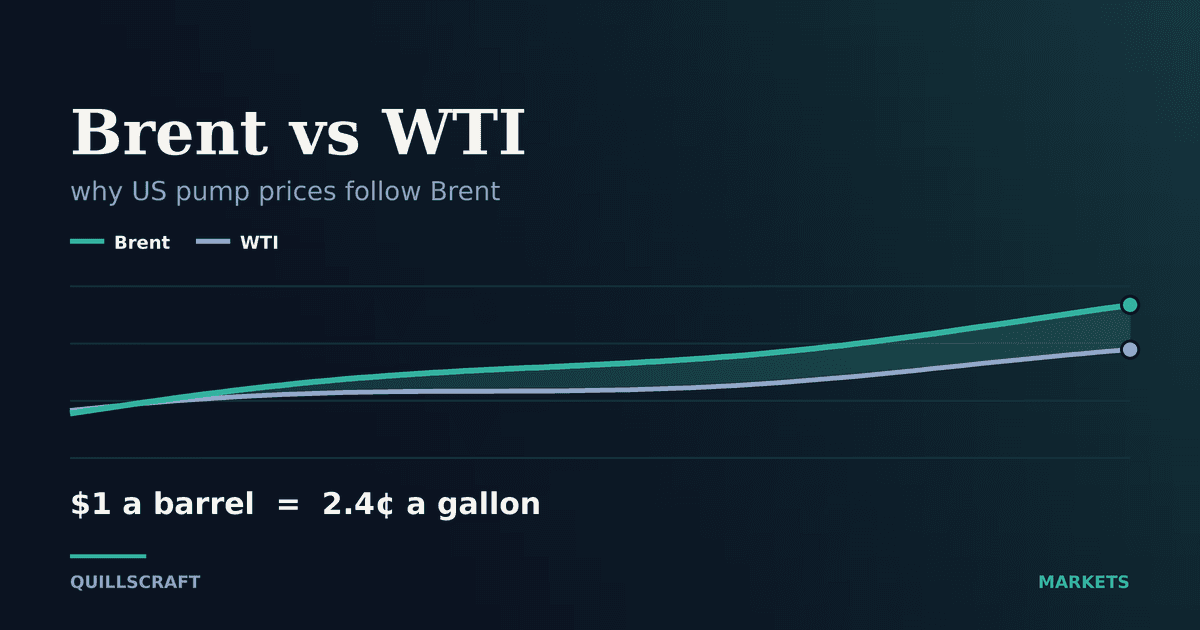
Brent vs WTI: Why US Pump Prices Follow the International Benchmark
The United States produces enormous quantities of oil and has its own crude benchmark. So when a Middle East disruption pushes global prices up, a reasonable question follows: why do American drivers pay more for fuel refined from American oil?
The answer sits in the gap between two price benchmarks, and in one fact about gasoline that most explanations leave out.
What Brent and WTI actually are
Both are reference prices for a specific grade of crude at a specific place. Neither is "the" oil price. They are quotes that thousands of other contracts get priced against.
West Texas Intermediate (WTI) is the North American benchmark. It is priced at Cushing, Oklahoma, an inland pipeline hub roughly 500 miles from the Gulf coast. Cushing is landlocked, and that single geographic fact shapes everything about how WTI behaves.
Brent is the international seaborne benchmark, drawn from North Sea fields. It is waterborne from the start, which means a cargo priced against Brent can sail to Rotterdam, Singapore, or Houston without touching a pipeline.
That difference in access is why Brent became the global reference. More than 70% of internationally traded crude is priced against it.
Why the two prices drift apart
For years the two tracked each other closely. Then in mid-2010 they separated, and the reason was plumbing rather than geopolitics.

Rising Canadian imports and surging US production overwhelmed the pipeline capacity running out of the Midwest. Oil piled up at Cushing with no efficient route to the coast. Landlocked supply with nowhere to go sells at a discount, and WTI fell below Brent.
The gap between them has narrowed and widened since, and the drivers are almost always physical: pipeline capacity, storage levels at Cushing, export terminal throughput, freight rates. When crude cannot easily reach the sea, the inland benchmark weakens against the seaborne one.
This is worth internalising because it explains why the spread is not a useful signal about global supply and demand. It is mostly a signal about American logistics.
The part most explanations miss
Here is the step that resolves the original question. Gasoline is itself a globally traded commodity.
The United States both imports and exports finished petroleum products. A refinery on the Gulf coast can sell its output domestically or ship it to Latin America or Europe, and it will send it wherever the return is highest. That choice links the US fuel market to the world fuel market regardless of which crude went into the barrel.
So a refiner is not asking "what did my crude cost?" It is asking "what can I sell this gasoline for on the open market?" That price is set internationally, and internationally the reference is Brent.
The EIA's analysis of this relationship found that US gasoline prices move with Brent rather than WTI. The finding that surprises people most: it holds true even in the Midwest, the region that physically surrounds Cushing where WTI is priced.
If cheap landlocked crude were going to produce cheap local fuel anywhere, it would be there. It does not.
How much a dollar of crude is worth at the pump
There is a useful rule of thumb. A $1 per barrel change in crude translates into roughly 2.4 cents per gallon of gasoline.
The arithmetic is straightforward. A barrel is 42 gallons, so a dollar spread across it is about 2.4 cents a gallon before any refining, distribution, or tax effects.
That converts abstract headlines into something checkable. If Brent rises $20 a barrel, expect somewhere near 48 cents a gallon to follow, arriving over days or weeks rather than immediately. During the 2026 Hormuz disruption, Brent moved from below $72 to above $98 in a matter of weeks, and the national average climbed to $4.091 a gallon. The relationship held.
Two caveats keep this honest. The rule describes the crude component only, and crude is the largest but not the sole input. Taxes, state fuel specifications, refinery outages, and regional distribution costs explain why the same national move produces different prices in California and Texas.
Why pump prices lag
Crude trades continuously. Gasoline reaches you through a physical supply chain that takes time.
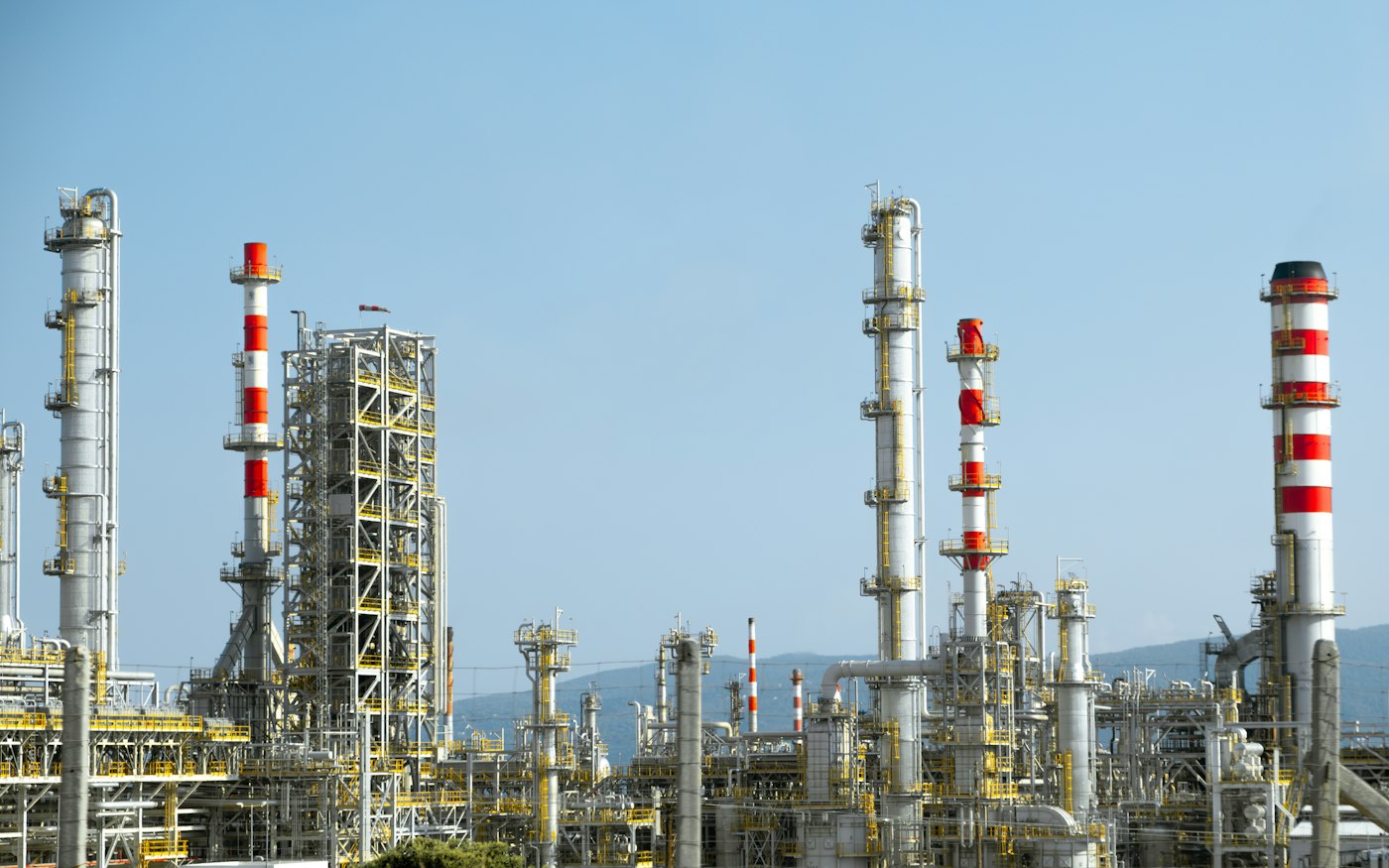
Refiners often buy crude weeks ahead. That oil is processed, moved to terminals, then trucked to stations, and each stage holds inventory bought at an older price. Retailers also price partly off replacement cost, meaning what they expect the next delivery to cost rather than what the fuel in their tanks actually cost.
The practical consequence is that pump prices keep rising for days after crude has stopped rising, and they fall more slowly than crude falls. That asymmetry is not necessarily price gouging. Much of it is inventory working through the chain.
If you want to anticipate what you will pay, watch Brent, not WTI, and expect a lag. Our explainer on why gas prices rise covers the current picture, and the Strait of Hormuz breakdown explains why a single shipping lane moves the benchmark in the first place.
Frequently asked questions
What is the difference between Brent and WTI?
Brent is the international seaborne benchmark from North Sea fields. WTI is the North American benchmark priced inland at Cushing, Oklahoma. Brent prices more than 70% of internationally traded crude.
Why do US gas prices follow Brent if WTI is the American benchmark?
Because gasoline is itself globally traded. The US imports and exports finished fuel, so refiners price output against the international market, and that market references Brent. EIA analysis found this holds even in the Midwest.
How much does a $1 rise in crude add to a gallon of gas?
About 2.4 cents, since a barrel holds 42 gallons. That covers the crude component only, before taxes and regional costs.
Why is WTI usually cheaper than Brent?
Mainly logistics. WTI is landlocked at Cushing, so when pipeline or export capacity is tight, inland crude sells at a discount to seaborne crude.
Why do pump prices fall more slowly than they rise?
Fuel already in the supply chain was bought at older prices, and retailers price partly off expected replacement cost. Inventory takes time to work through.
Bottom line
The United States can be a major oil producer and still see pump prices set by events on the other side of the world. That is not a contradiction or a market failure.
Crude and gasoline are both globally traded, the international reference for both is Brent, and 42 gallons to the barrel does the rest. Watch Brent, apply 2.4 cents per dollar, and allow a week or two for it to arrive.


