
Sports Technology Labs: Products, Testing and Key Facts
Searching for Sports Technology Labs can be confusing. Despite its name, this company is not a biomechanics facility or an athlete-performance laboratory. It is a US-based online supplier that markets SARMs, peptides, and related compounds for laboratory research.
That distinction matters. The company states that its products are intended exclusively for research and development—not human consumption, veterinary use, or household purposes. This overview explains what the business offers, how its testing documents can be evaluated, and what buyers should understand before relying on claims about purity or quality.
Information checked July 15, 2026. This article is educational and does not provide medical advice or recommend purchasing or using research chemicals.
What Is Sports Technology Labs?
Sports Technology Labs describes itself as a supplier serving businesses and research institutions. Its website lists liquid and powdered SARMs, peptides, product combinations, and wholesale options.
The company also publishes contact information, ordering policies, FAQs, and certificates of analysis. Its listed address is in Shelton, Connecticut. However, a business address should not automatically be interpreted as the location where products are manufactured or tested.
The name should not be confused with sports science laboratories that use biomechanics, motion capture, and wearable technology to evaluate athlete performance. Sports Technology Labs operates in the research-chemical market instead.
What Products Does the Company List?
The catalog is organized into two main categories:
SARMs and peptides. SARMs are experimental compounds associated with selective androgen receptor research. Peptides are short chains of amino acids studied across different areas of laboratory research.
The presence of a product in an online catalog does not mean the FDA has approved it. Sports Technology Labs acknowledges that its products and website claims have not been evaluated by the FDA and that the products are not intended to diagnose, treat, cure, or prevent disease.
The company’s terms further state that products should be handled only by trained professionals who understand applicable regulations and laboratory hazards. Readers should treat this restriction as a substantive safety boundary, not a routine website disclaimer.
How Sports Technology Labs Presents Its Testing
Sports Technology Labs publishes certificates of analysis, commonly called COAs, for products listed on its website. The company says samples undergo third-party testing and generally identifies high-performance liquid chromatography, or HPLC, as a method used to assess purity.
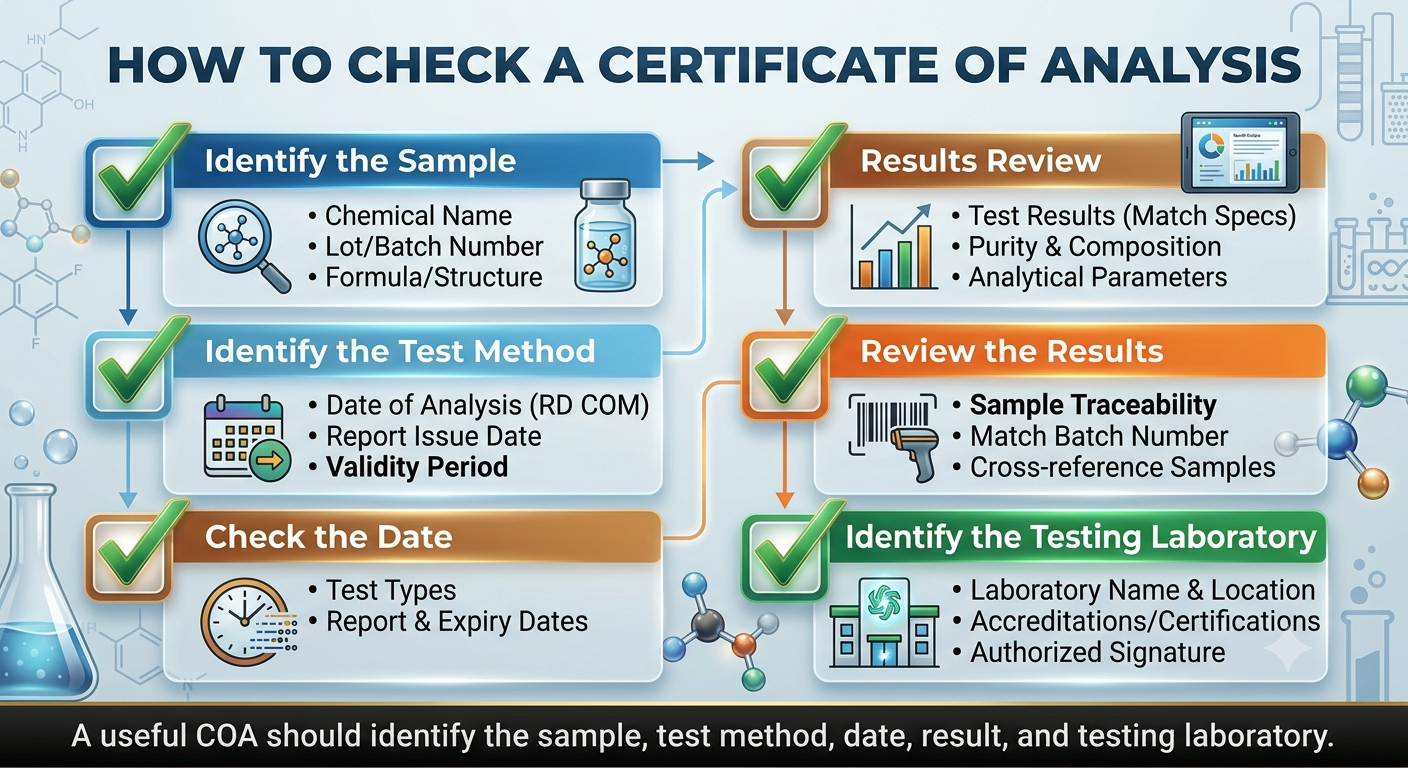
A COA can provide useful information, but only when it matches the product and batch being evaluated. When reviewing one, check for:
1. The compound and sample name
2. A batch or lot identifier
3. The date of testing
4. The method used
5. The reported result and units
6. The testing laboratory’s identity
7. Contact details or another way to verify the report
The company itself recommends contacting the named laboratory to confirm that a certificate is genuine. Its current COA library (https://sportstechnologylabs.com/coas/) includes reports with different dates
and reported purity levels, so readers should inspect the document for the specific product rather than relying on a general testing statement.
What a COA Does Not Prove
A purity result is not the same as proof of safety, effectiveness, sterility, or FDA approval. Depending on the analysis performed, a COA may also leave unanswered questions about contaminants, residual solvents, microorganisms, endotoxins, concentration, or consistency between the tested sample and the delivered product.
The FDA explains that unapproved drugs have not undergone its review for safety, effectiveness, quality, and labeling. Without that review, consumers do not receive the same assurances attached to an approved drug. FDA guidance on unapproved drugs (https://www.fda.gov/drugs/enforcement-activities-fda/unapproved-drugs)
Ordering, Shipping, and Returns
According to the company’s current FAQ page (https://sportstechnologylabs.com/faqs/), orders are generally shipped within one business day, and domestic delivery usually takes three to five business days. The page also describes tracking, payment methods, exchanges, and shipping limitations.
These are company-published policies rather than guarantees from an independent source. Terms can change, and parts of a website may not always be updated simultaneously. Researchers should save the applicable policy, order confirmation, product description, and COA at the time of a transaction.
Is Sports Technology Labs Legit?
“Legit” can refer to several different questions: Is the business operating? Does it send orders? Are its testing reports authentic? Do delivered products match their labels? A website, contact address, or COA cannot answer all of them.
Sports Technology Labs provides visible business policies, research-use disclaimers, contact information, and testing documents. Those are useful transparency signals, but they do not independently establish the identity or quality of every delivered batch. Online testimonials are also weak evidence because their authorship, product handling, and testing conditions usually cannot be verified.
A responsible assessment should rely on batch-specific documentation, direct confirmation from the testing laboratory, applicable laws, and qualified professional oversight—not anonymous reviews or marketing language.
Frequently Asked Questions
1. Is Sports Technology Labs an athlete testing facility?
No. It is a research-chemical supplier, not a sports science, biomechanics, or performance-analysis laboratory.
2. Are its products FDA-approved?
The company states that its products and claims have not been evaluated by the FDA. “Research use only” is not equivalent to FDA approval.
3. Does a high purity result mean a product is safe?
No. Purity is only one measurement. It does not establish clinical safety, sterility, effectiveness, or suitability for human use.
Conclusion
Sports Technology Labs publishes more company, policy, and testing information than a simple storefront might provide. Still, every claim should be evaluated within its limits. Research-use labeling, batch-specific verification, and the distinction between a COA and regulatory approval are essential to understanding Sports Technology Labs responsibly.