
Google vs Tesla AI Investment 2026: Who Is Seeing Real Returns?
Google and Tesla both reported higher revenue in the second quarter of 2026, but investors reacted to a less comfortable number: how much each company plans to spend on artificial intelligence.
Alphabet is pouring money into data centers, servers, custom chips, and its Gemini models. Tesla is investing in AI computing, robotaxis, the Cybercab, and its Optimus humanoid robot. The Google vs Tesla AI investment comparison shows two companies making very different bets on how artificial intelligence will create value.
Google already has signs that its spending is generating revenue. Tesla is asking investors to wait longer while it builds products that may reshape the company or place more pressure on its profits.
What Google and Tesla reported
Both companies recorded strong revenue growth during the April to June quarter. Their earnings, however, tell different stories.
In the second quarter of 2026, Alphabet reported revenue of $119.8 billion, up 24% from the previous year. Tesla generated $28.24 billion in revenue, representing 26% growth. On its July 2026 earnings call Alphabet's finance chief raised the company's 2026 capital investment guidance to between $195 billion and $205 billion, up from $180 billion to $190 billion. That range is guidance given on the call, not a figure in Alphabet's quarterly filing, with much of its strategy focused on Google Cloud, Gemini, data centers, and AI chips. Tesla expects capital spending to exceed $25 billion as it invests in robotaxis, Cybercab production, Optimus, and AI computing infrastructure. Alphabet's Google Cloud revenue grew 82%, while Tesla's research and development spending increased 49% as its net income declined.
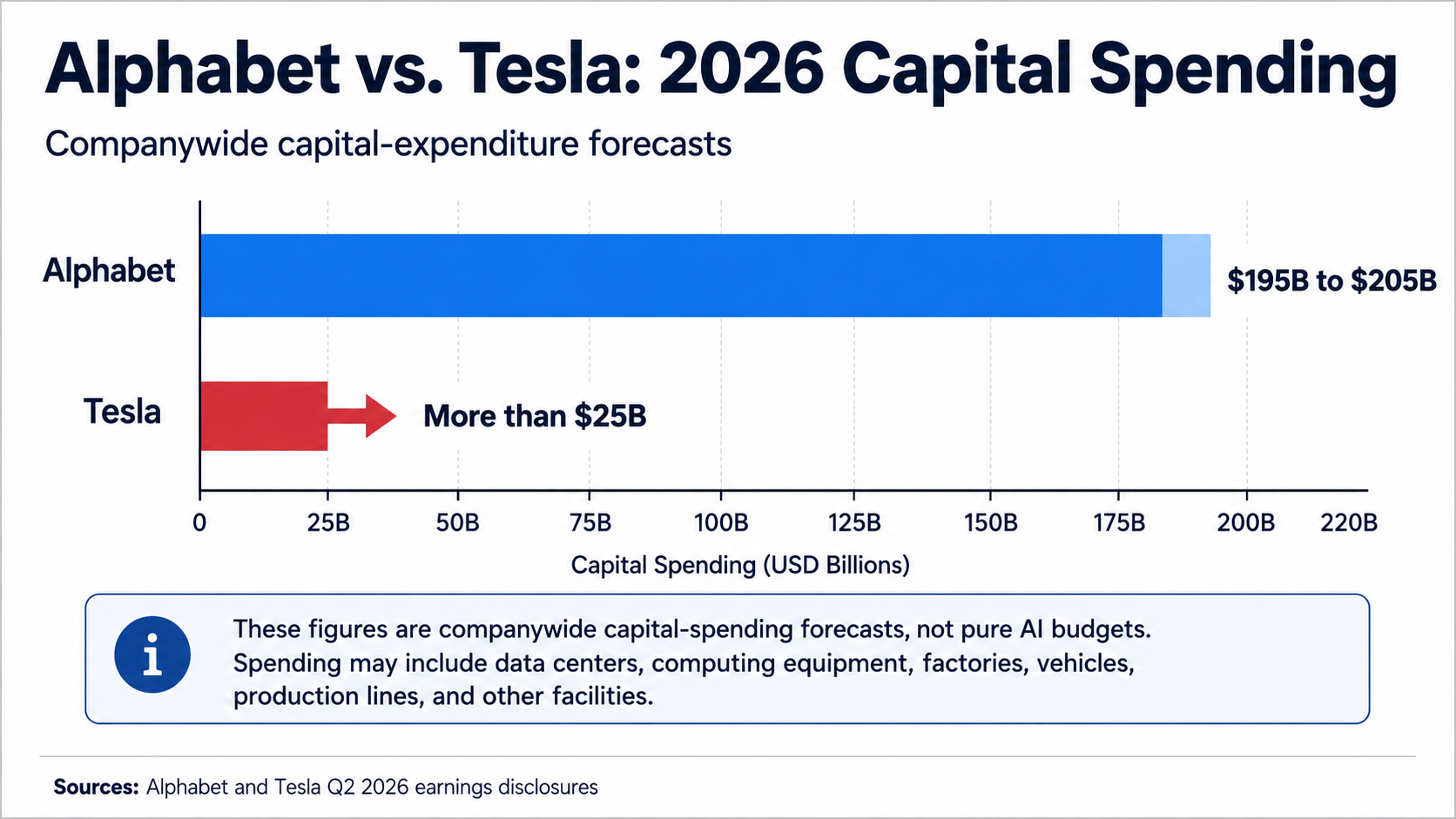
These capital-spending forecasts are not direct AI budgets. They also cover equipment, facilities, and other operations. Comparing them still gives readers a sense of the scale of the AI investment race.
What the Alphabet Q2 2026 earnings revealed
Alphabet reported $119.8 billion in quarterly revenue, an increase of 24% from the previous year. Search and related advertising revenue grew 17%, while Google Cloud revenue jumped 82%.
According to Alphabet CEO Sundar Pichai (https://blog.google/company-news/inside-google/message-ceo/alphabet-earnings-q2-2026/), Google Cloud's backlog reached $514 billion. The Gemini app had 950 million monthly active users, and the company's model APIs were processing about 22 billion tokens per minute.
Google Cloud AI growth was the clearest sign that Alphabet's infrastructure spending was producing business results. These numbers do not prove that every dollar spent on AI will deliver an attractive return, but Google can already connect its spending to paying cloud customers, advertising growth, and wider Gemini use.
Investors still showed concern after Alphabet raised its expected 2026 capital spending to between $195 billion and $205 billion. Much of that money will support AI data center infrastructure, servers, and computing equipment. Those assets are expensive to build and continue costing money through electricity, maintenance, and depreciation.
A common mistake in Alphabet earnings coverage
Alphabet's reported quarterly net income was unusually high because it included a gain of about $98 billion from equity investments. Revenue was $119.8 billion, while net income was reported at $112.11 billion.
That investment gain makes a simple profit comparison with Tesla misleading. Operating growth in Search and Google Cloud provides a more useful measure of whether Alphabet's AI strategy is working.
What the Tesla Q2 2026 earnings revealed
Tesla's revenue rose 26% to $28.24 billion, helped by stronger vehicle sales. Net income fell to $1.11 billion, and adjusted earnings missed analysts' expectations.
Research and development spending increased by approximately 49% to $2.37 billion. Tesla expects its total capital expenditures to exceed $25 billion in 2026, with spending likely to remain elevated for the next two to three years.
The Tesla robotaxi and Optimus projects account for part of the company's growing investment in computing, research, and manufacturing. Tesla says its robotaxi service has reached seven U.S. metropolitan areas. The company has also started Cybercab production in Texas and expects Optimus production to begin later in 2026.
These projects could open new revenue sources, but they still carry substantial execution risk. Robotaxis need regulatory approval, reliable autonomous-driving technology, and public trust. Humanoid robots must move beyond demonstrations and perform useful work at an acceptable cost.
Tesla's existing automobile business is financing much of that transition. If robotaxis and Optimus develop slowly, the spending could continue reducing profit without producing enough new revenue to compensate.
What the Google vs Tesla AI investment race reveals about AI capital spending
Google is mainly investing in digital AI. Its systems support Search, Gemini, advertising, and cloud customers. The company can distribute a new AI feature to millions of users without manufacturing a physical product for each person.
Tesla is focused on physical AI. A robotaxi requires a vehicle, cameras, computing hardware, maintenance, insurance, and permission to operate. Optimus requires factories and a dependable supply chain. That makes Tesla's expansion slower and more capital intensive.
For now, Google has clearer evidence of AI monetization. Cloud revenue and contract backlog are growing rapidly. Tesla has an ambitious product roadmap, but the financial return from robotaxis and robots remains harder to measure.
Frequently asked questions
Is Tesla still primarily a car company?
Vehicle sales produce most of Tesla's revenue. However, management increasingly describes AI, autonomous transportation, energy, and robotics as the company's future growth areas.
Is Google's AI investment already profitable?
Alphabet does not publish one profit figure covering all its AI products. Strong Google Cloud growth and continued Search advertising gains suggest that AI is supporting revenue, but the full return must eventually justify higher infrastructure and depreciation costs.
Conclusion
The Google vs Tesla AI investment comparison reveals two very different business models. Google is expanding digital services that already reach large consumer and business markets. Tesla is spending on physical products that could take longer to mature.
Google currently has stronger evidence that AI spending is translating into business growth. Tesla may produce a larger transformation if robotaxis and Optimus succeed, but that strategy carries more uncertainty and is already placing pressure on profit.


