
Business Property to Let: How to Choose the Right Commercial Space
Finding a business property to let involves more than comparing rent and
square footage. The right space must support your daily operations, customers,
employees, and future growth without creating costs your business cannot
comfortably carry.
In the United States, listings generally use “commercial property for lease”
rather than “to let.” Searching both phrases can still uncover more
opportunities, particularly when owners market properties themselves.
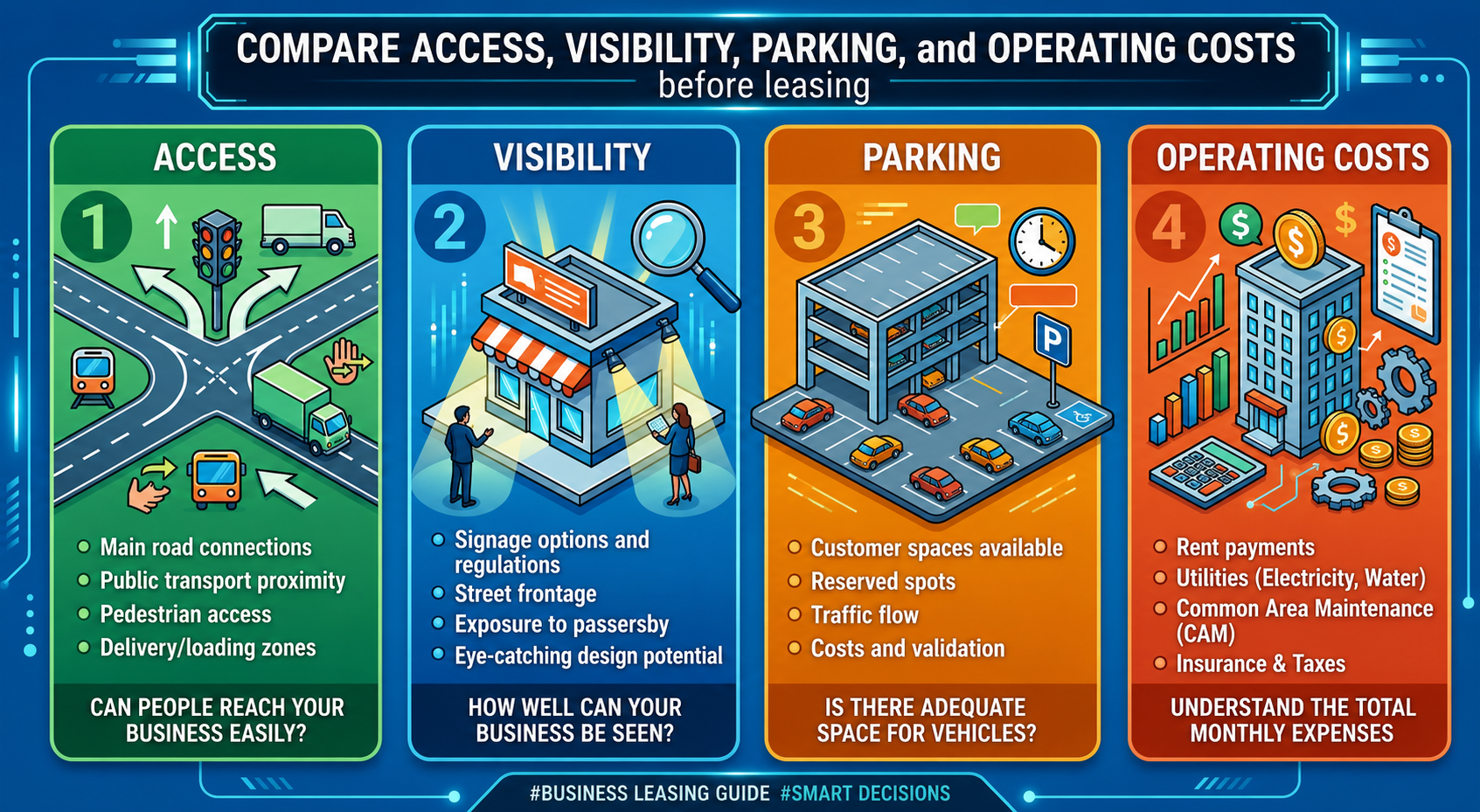
How to Choose a Business Property to Let
Start by defining what the business actually needs. A prestigious address
provides little value if deliveries are difficult, customers cannot park, or
the building lacks the required electrical capacity.
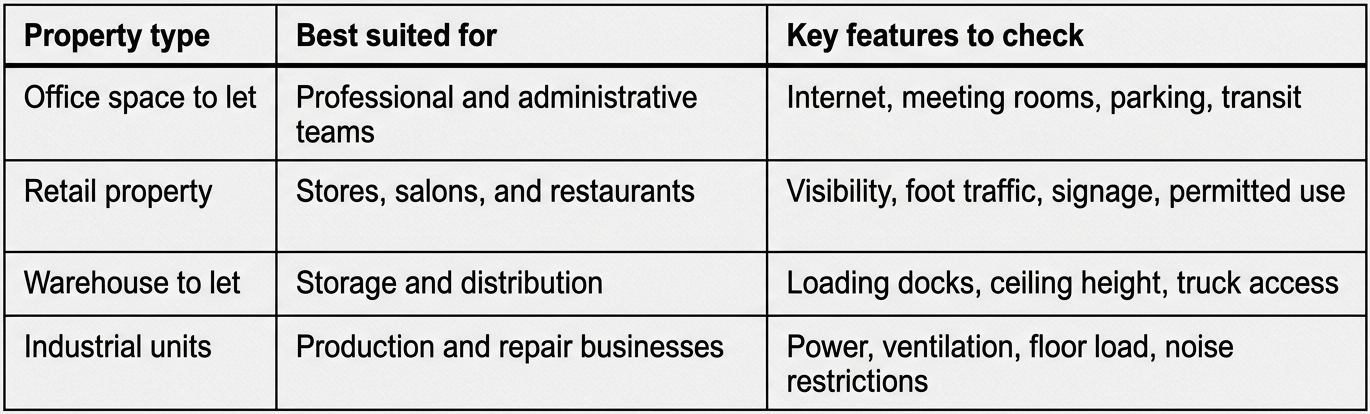
Different property types serve different purposes. Office space to let is best
suited to professional and administrative teams, with internet connectivity,
meeting rooms, parking, and public transit among the main considerations. A
retail property works well for stores, salons, and restaurants, where
visibility, foot traffic, signage, and permitted use are especially important.
A warehouse to let is designed for storage and distribution, so businesses
should check loading docks, ceiling height, and truck access. Industrial units
suit production and repair businesses that may require sufficient electrical
power, ventilation, floor-load capacity, and workable noise restrictions.
Create a short list of non-negotiable requirements before contacting a broker
or commercial landlord. Include your preferred area, usable square footage,
maximum occupancy cost, move-in date, parking needs, and expansion plans.
Evaluate the location in person
Visit each property during normal business hours and, if relevant, during
evenings or weekends. Observe traffic, access, lighting, neighboring
businesses, and street activity.
For a retailer, customer visibility may justify higher rent. A distributor may
gain more from highway access and an efficient loading area. Confirm the
proposed use with the local zoning or planning department instead of relying
solely on a listing description.
Calculate the Full Cost of Commercial Property to Let
The advertised rent rarely represents the complete cost of occupying business
premises. Ask for a written breakdown covering:
- Base rent and scheduled increases
- Common-area maintenance charges
- Property taxes and insurance contributions
- Utilities, waste collection, and security
- Repairs and HVAC maintenance
- Buildout, permits, furniture, and signage
- Deposit, broker, legal, and moving costs
Compare properties by annual occupancy cost rather than base rent alone. For
example, a space priced at $4,000 per month with substantial maintenance
charges could cost more than a better-equipped property advertised at $4,500.
The IRS states that rent for property used by a business is generally
deductible, although advance payments and purchase-like arrangements may
receive different treatment. Review the IRS guidance on small-business rent
expenses
(https://www.irs.gov/newsroom/small-business-rent-expenses-may-be-tax-deductible)
and consult a tax professional about your circumstances.
Understand the lease structure
A commercial lease may allocate building expenses in several ways:
- Gross lease: The tenant pays rent while the landlord covers most property
expenses.
- Modified gross lease: The parties divide specified operating expenses.
- Net or triple-net lease: The tenant pays base rent plus some or all taxes,
insurance, and maintenance.
Labels are not enough. Read the expense provisions and request recent
operating-cost records where available.
Complete Due Diligence Before Signing
Use this checklist before committing to a commercial lease:
1. Inspect the building. Have qualified professionals examine the roof, HVAC,
plumbing, electrical systems, and any environmental concerns relevant to
the intended use.
2. Confirm legal use. Verify zoning, occupancy limits, licenses, signage
rules, and building-code requirements with the appropriate authorities.
3. Test operational fit. Measure usable space and check internet service,
deliveries, parking, security, accessibility, and emergency access.
4. Review every lease term. Examine renewal options, rent increases, personal
guarantees, repair duties, insurance, assignment rights, default
provisions, and early termination.
5. Document promised work. Put buildout allowances, repairs, completion dates,
and rent-free periods in the lease agreement.
6. Clarify accessibility duties. Both landlords and tenants can have
responsibilities under the Americans with Disabilities Act; a private
allocation in the lease does not remove their potential legal liability.
See the Department of Justice’s ADA guidance
(https://www.ada.gov/resources/title-iii-manual/).
A commercial real estate attorney should review the final agreement. A tenant-
focused broker can also provide comparable rents and help negotiate
concessions.
Should You Lease or Buy?
Leasing usually preserves cash, offers flexibility, and transfers some
building responsibilities to the owner. It can suit a small business that is
growing or testing a new market.
Reviewing commercial premises for sale may make sense when your location needs
are stable, you can fund the down payment and improvements, and ownership
supports a long-term strategy. Purchasing also introduces financing,
maintenance, liquidity, and resale risks. Compare five- or ten-year cash-flow
scenarios rather than assuming ownership is automatically cheaper.
Common Mistakes to Avoid
- Choosing a property based only on rent
- Underestimating buildout time and permit costs
- Accepting verbal promises from the landlord
- Ignoring renewal and exit provisions
- Signing a personal guarantee without legal advice
Frequently Asked Questions
1. How long is a commercial lease?
Terms vary by property and market. Shorter terms offer flexibility, while
longer terms may provide rent stability and justify major improvements.
Negotiate renewal options before signing.
2. Can commercial rent be negotiated?
Yes. Base rent, increases, deposits, improvement allowances, free-rent
periods, maintenance duties, and renewal rights may all be negotiable.
3. How much space should a business lease?
Base the decision on usable space, staffing, equipment, customer flow,
storage, and realistic growth. Avoid paying for speculative expansion that may
never occur.
Conclusion
The best business property to let is not necessarily the cheapest or most
impressive. It is the space that meets operational requirements at a
sustainable total cost. Compare several properties, verify zoning and building
condition, and have the lease reviewed before committing. Careful due
diligence now can prevent expensive restrictions and disputes later.